TRAFFIC SIGNALS: THE YELLOW TRAP DANGER
(In countries where cars drive on the left side of the road, interchange the words "right" and
"left" throughout the remainder of this article.)
Many new traffic signals have left turn signals. These are very helpful when traffic is heavy, and left
turns would not otherwise be possible, due to lack of gaps in opposing traffic to turn through. When traffic
is light, however, left turn signals can cause a hidden danger that is called yellow trap, lag trap, or the
left-turn trap. Here is a description of yellow trap, and how it causes the danger:
Terminology.
HOW YELLOW TRAP HAPPENS
 Yellow trap occurs only when all of these conditions are simultaneously met:
- Left turns can be made through gaps in traffic during the circular green.
- Both circular greens for the same street are displayed together.
- One circular green terminates before the other one does.
The left-turning driver with the shortened green expects oncoming traffic to stop.
 The above sequence of events causes the following events to happen:
- A driver wants to turn left from the approach oncoming to the left turn phase.
- The turning driver is waiting in the intersection for gaps in oncoming traffic.
- The turning driver's circular green changes to circular yellow.
- The turning driver can not know that the other approach still has a circular green.
The signals for the oncoming approach are invisible to this driver.
- The light is turning red. The turning driver must clear the intersection by law.
- The turning driver expects oncoming traffic to stop for the yellow or red light.
- A driver proceeding straight ahead on the other approach still has a circular green.
- The oncoming driver expects the left turning driver to yield.
- Neither driver knows anything is wrong.
- Each driver is obeying the law according to the display given that driver.
- A collision occurs.
Neither driver is at fault here. The signals displayed to them caused the accident. At least one court
has ruled that both drivers could sue the government due to this type of accident. The yellow trap has
long been recognized in signals that repeat the same sequence each cycle. The big problem now is the
signal that changes the phase order to meet traffic demand.
Take my Yellow-Trap Quiz to see if you really understand the
problem.
ANIMATION OF DOGHOUSE YELLOW TRAP WITH LEAD-LAG PHASING
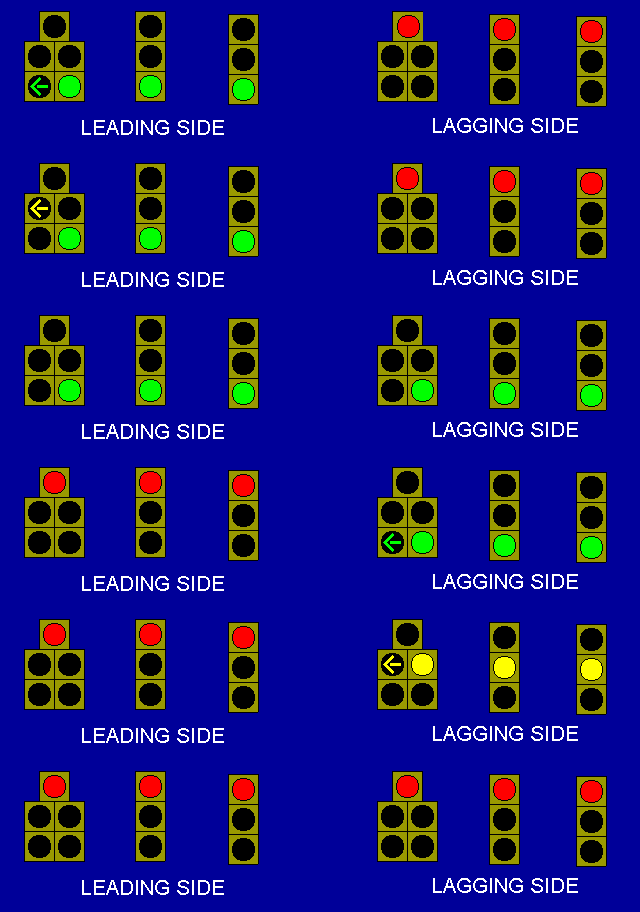
HOW TO AVOID A YELLOW TRAP CRASH
Now, as a driver, what can you do to avoid the trap? Here are some tips:
- NEVER wait in an intersection to turn left.
- If you find yourself waiting in the intersection when the yellow and red appear, keep waiting for
gaps in oncoming traffic.
- Report any yellow trap sequence you see happen as a signal failure. You may see a car inexplicably
turn in front of you when you have a circular green, or a circular green plus an arrow. You also might
see a car with a red light waiting in the intersection to turn through a stream of traffic coming
toward it. Also note the location for your future driving reference.
- If you see all of these, prepare to avoid a car turning across you:
- Your approach has a left turn signal.
- No cars are waiting on the crossroad.
- An oncoming car is waiting to turn left.
- If you are turning left, and there is a visible detector loop where the first car stops in the
left turn lane, stay on it until you can turn.
- Realize that devices other than left turn signals can create yellow trap. These include:
- Sequences for unusual intersection geometry.
- Special sequences for pedestrian movements.
- Emergency vehicle pre-emption.
- Railroad, drawbridge, or queue-discharge pre-emption.
- Right turn signals.
- If you are turning right, and your signal changes from circular green (or flashing yellow arrow)
to a green right-turn arrow, watch for left-turning traffic clearing the intersection.
REMOVING YELLOW TRAP FROM SIGNALS
The real problem is the use of the circular green for the permissive turn indication. Since it
also gives a "go" signal to traffic moving straight ahead, it must be ended at the wrong
time in the signal cycle to stop the other traffic. Another indication is
needed for a permissive left turn.
For the traffic engineer, I propose the following rules:
A new solution has become available. It is the
Flashing Yellow Arrows solution. The necessary change in the
Manual of Uniform Traffic Control Devices (MUTCD) has been made with the new 2009 MUTCD. But it
requires states to give up their aversions to red arrows.
Here is a visual example of flashing yellow arrows.
Since yellow trap occurs whenever permissive turns are cut off early to give the opposite
approach a left turn phase, something can be done about it. Notice that yellow trap from a
left-turn sequence cannot occur from a given road (check crossroad left turns separately)
where:
- There is a Tee intersection, unless a driveway makes a fourth leg.**
- Left turn phases do not exist.**
- Only one left turn from that road exists.**
- All left turns on that road have
exclusively protected (3-light) signal faces.
- Both left turns are leading, unless all crossroad phases can be skipped together.**
- Both left turn signals always act in unison.**
- Both circular greens for that road can never be displayed at the same time.**
** Note that yellow trap from special sequences, pre-emption sequences, or right-turn signals can
still happen with these arrangements.
The following list gives the remedies for correcting a fixed sequence yellow trap at crossroads. Any
one of them will correct the problem (unless it is caused by a right-turn signal):
- Change to a leading left turn sequence.
- Give both left turns on the road exclusively protected (3-light) left
turn signals.
- Prohibit the oncoming left turn.
- Put up an "ONCOMING TRAFFIC MAY HAVE EXTENDED GREEN" sign (doesn't work very well).
- Put up a "NO LEFT TURN ON CIRCULAR YELLOW" sign (doesn't work very well).
- Divert left turns away from the intersection.
- Use the Flashing Yellow Arrows solution.
Why Flashing Yellow Arrows Work shows an additional reason why
yellow trap occurs. Improper implementation of permissive left turns hands the timing of turn
movements back and forth between timing rings in the signal controller.
Here is a table of signal types, and the measures necessary to prevent
the yellow trap problem at each.
A SNEAKY FORM OF YELLOW TRAP
The sneaky kind of yellow trap is one that happens at a signal with a leading turn sequence and
phase skip. When the intersection is busy, nothing goes wrong. But when traffic is light, the
following can happen:
- No traffic appears on the cross road to call any crossing phase.
- One or more cars wait to turn left, triggering the left turn phase detector.
Or the left turn phase is on recall.
- One or more cars approach from the opposite direction to turn left.
- A gap appears in straight ahead traffic on the opposite approach.
Or one straight-ahead phase times out on maximum or fixed time.
- The opposite approach gets a circular yellow. The signal does an unusual lagging turn
sequence.
- The opposite approach car turns left into triggered approach straight ahead traffic, for the
same reasons given above.
Clearly, a yellow trap has occurred. This type is more insidious, because it is unexpected. It
does not happen very often, and then only under (normally safer) light traffic conditions. Often the
officials involved are unaware that it is happening, since it usually happens at night. The above
remedies work, but if the first one is followed, or is already in place, then one of the following
must be also used to correct the problem. These remedies are more technical than the ones above:
- Use the Flashing Yellow Arrows solution. (a, e)
- Use Dallas Phasing, if geometry and signal mounts allow. (a, e - but apparently no longer
approved)
- Lock out calls to the left turn phase while the oncoming circular green is displayed. (b)
- Redirect left turn calls to the circular green during the oncoming circular green. This extends
the green until they can turn. (b)
- Recall one of the crossroad phases to display a green every cycle. (c)
- Create a dummy phase to operate concurrently with (or in place
of) a crossroad phase. (c)
It should have no display, and its timing should be minimal. Connect the left turn phase detectors
to its calling detector input.
- Connect each left turn detector output to the calling detector input of a cross-street phase
in the same timing ring. (c)
- Give both approaches on the road exclusively protected (three light)
left turn signals (d, e).
- Divert one or more left turns away from the intersection. (d)
The above remedies have the following properties (letters in parentheses above).
- Lets permissive left turns continue until the opposing thru phase ends.
- Prevents left turn phases from acting until crossroad traffic has been served.
- Makes an interval of red precede the left turn phase with a crossroad green or all-red
interval.
- Removes the permissive turns that really cause the problem.
- Requires new signal faces.
Many traffic signal controllers have provisions to implement many of these changes
ODD INTERSECTIONS AND PRE-EMPTIONS
Yellow trap can also occur when special sequences other than left turn sequences are programmed
into the signal. This can happen only if the sequence can separately terminate circular greens on
the same street. Watch sequences for odd geometry, extra legs, pedestrians, and pre-emptions for
emergency vehicles, railroads, draw bridges, etc. The cures are:
- Make all left turns exclusively protected to remove turns on circular
greens.
- Provide a short (5 second) all-red period, then redisplay the one circular green.
- Divert one or more left turns away from the intersection.
- Use the Flashing Yellow Arrows solution.
Layman politicians often make demands that pre-emptions must protect government employees in
emergency vehicles from all other traffic. Care must be taken not to put other drivers in danger
from yellow trap to please the politicians. The pre-emption should always be treated the same as a
lagging left turn phase.
Yellow trap and pre-emptions
SECOND YELLOW TRAP - ANOTHER SNEAKY KIND
Second yellow trap occurs when ANY permissive left turn movement is
brought into conflict with the opposing right-turn movement, when that right turn movement is
changing from permissive to protected, to overlap a cross-street left-turn movement. Left-turn
signals do not even need to be present on the affected street for this to happen.
The following are cures:
- Remove the right turn signal. Use a shared face with only circular indications.
- Channelize the right turn into its own lane.
- Replace the right turn signal with a YIELD sign.
- Add a brief clearance and red indication (~5 seconds) to the right turn.
THIRD YELLOW TRAP - YET ANOTHER SNEAKY KIND
Third yellow trap occurs when a permissive left turn movement using a
flashing yellow or red arrow is terminated before the oncoming thru phase due to the reservicing of
a phase that requires the flashing yellow or red arrow to be delayed until a period after that
phase starts.
The following are cures:
- Remove the delay from the flashing yellow or red arrow phase.
- Prevent the delay from asserting itself if the flashing yellow or red arrow phase is already
active.
- Force both phases into red before reservicing.
LITTLE YELLOW TRAP AND GREEN TRAP
Little Yellow Trap occurs when the circular greens for both
directions end at the same time, but the circular yellows do not. When the shorter yellow turns red,
the driver thinks the other direction is red too, and completes his turn. But an oncoming straight-ahead
driver could continue on through during this period, causing a crash.
Little yellow trap happens when the yellow change intervals of the two phases are set to different
values.
The following are cures:
- Set the yellow clearance intervals on both phases to the same value.
- If there are no turn arrows on the street, use the same phase unit for both circular greens.
Green trap occurs where there are no left turn phases, but the
circular greens facing opposite directions can start at different times. This fools a left turning
driver when an opposing driver suddenly gets a circular green and starts to move.
In green trap, the left turning driver sees an oncoming car slowing down for a red signal, so he thinks
he has the right-of-way. As the oncoming driver enters the detector, his signal suddenly turns green, and
he speeds up to go straight or right, entering the intersection in the path of the left turning vehicle.
This can cause a crash.
Green trap happens when opposite circular greens on the same road have their own phase units, but no
other phase units are in the concurrency group. One phase stays red until a car appears on the
approach.
Cures for green trap:
- Use the same phase unit for both circular greens.
- Force display of concurrent greens in both timing rings.
PAGE LINKS
LINKS
- All Yellow Trap Links are here:
YELLOW TRAP INDEX PAGE
- Do you understand yellow trap?
- Unusual Traffic Problems, Hazards, and Solutions
- Two New Approaches to the Problem
- Yellow Trap in Bloomington Indiana
- HOME