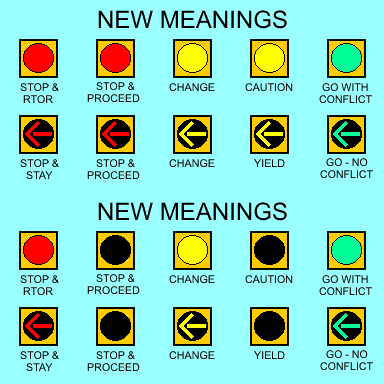
The following are definitions used for traffic signal design and timing:
 Doghouse signal: A shared turn signal with five lights (red, yellow, green,
yellow arrow, green arrow) arranged in a cluster, as shown at the right. The name comes from the
shape of the signal face, which roughly resembles a doghouse.
Doghouse signal: A shared turn signal with five lights (red, yellow, green,
yellow arrow, green arrow) arranged in a cluster, as shown at the right. The name comes from the
shape of the signal face, which roughly resembles a doghouse.Beware of yellow trap during pre-emptions
 Exclusively Protected left turn signal: (also ungrammatically called
"protected-only.") A left turn signal face with three lights (red, yellow-arrow, and
green-arrow) that stops all left turns when the green arrow is not displayed. Some states use
all-arrow heads, others do not allow the red arrow, and use circular red instead.
Exclusively Protected left turn signal: (also ungrammatically called
"protected-only.") A left turn signal face with three lights (red, yellow-arrow, and
green-arrow) that stops all left turns when the green arrow is not displayed. Some states use
all-arrow heads, others do not allow the red arrow, and use circular red instead.
Left turns are allowed only when the green arrow is on, not on a circular green displayed on another signal face. The yellow arrow clears out traffic from the green arrow at the end of the phase. The circular red or red arrow stops all left turn traffic until the green arrow shows again.
The only way yellow-trap can occur at one of these signals is if left turns from the opposite direction are permitted on a circular green.
Protected-Permissive (P-P) left turn signal: A left turn signal with five
lights (red, yellow, green, yellow arrow, green arrow) that allows left turns to be made
through gaps in traffic during the circular green portion of the cycle. A circular red is
always used here, because it stops straight ahead as well as left turn traffic.
Traffic turning left is protected from conflict whenever the green arrow is on. When just the circular green is on, the left turns must yield to oncoming traffic. When the yellow arrow is lit along with the circular green, it means that left turns will no longer be protected from conflict, and will have to yield to oncoming vehicles during the period the circular green is shown alone.
Yellow-trap can occur with these whenever oncoming traffic is given a left turn arrow immediately after both streets have had circular green.
 Alternate Flashing Yellow Arrows Display: Prevents Yellow-Trap by using a
flashing yellow arrow to extend the opposing permissive left turn through the lag turn phase,
without extending the circular green. Flashing yellow arrows needs the special signal face
shown at right. This is the same as a protected-permissive signal face, except that an extra
yellow arrow is included. The upper yellow arrow and the circular yellow are used for yellow
clearance. The lower one flashes for permissive turns. An alternate version of this face has
all arrow indications.
Alternate Flashing Yellow Arrows Display: Prevents Yellow-Trap by using a
flashing yellow arrow to extend the opposing permissive left turn through the lag turn phase,
without extending the circular green. Flashing yellow arrows needs the special signal face
shown at right. This is the same as a protected-permissive signal face, except that an extra
yellow arrow is included. The upper yellow arrow and the circular yellow are used for yellow
clearance. The lower one flashes for permissive turns. An alternate version of this face has
all arrow indications.
Traffic turning left is protected from conflict whenever the green arrow is on. When the (lower) yellow arrow is flashing, the left turns must yield to oncoming traffic. When the upper yellow arrow is lit, it means that the left turn movement is ending, or that it will have to yield to oncoming vehicles during the period the flashing yellow arrow is shown. The circular yellow means that the flashing yellow arrow period is ending.
Yellow-trap can not occur if this display is shown to both approaches on the same road. But second yellow trap can occur if not prevented.
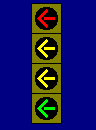 Flashing Yellow Arrows: Prevents
Yellow-Trap by using a flashing yellow arrow to extend the opposing permissive left turn through the
lag turn phase, without extending the circular green. Flashing yellow arrows needs the special signal
face shown at right. This is the same as an exclusively protected signal face, except that an extra
yellow arrow is included. The upper yellow arrow is used for yellow clearance. The lower one flashes
for permissive turns.
Flashing Yellow Arrows: Prevents
Yellow-Trap by using a flashing yellow arrow to extend the opposing permissive left turn through the
lag turn phase, without extending the circular green. Flashing yellow arrows needs the special signal
face shown at right. This is the same as an exclusively protected signal face, except that an extra
yellow arrow is included. The upper yellow arrow is used for yellow clearance. The lower one flashes
for permissive turns.
Traffic turning left is protected from conflict whenever the green arrow is on. When the (lower) yellow arrow is flashing, the left turns must yield to oncoming traffic. When the upper yellow arrow is lit, it means that the left turn movement is ending, or that it will have to yield to oncoming vehicles during the period the flashing yellow arrow is shown.
Yellow-trap can not occur if this display is correctly implemented and shown to both approaches on the same road.
In green trap, a left turning driver sees an oncoming car slowing down for a red signal, so he thinks he has the right-of-way. As the oncoming driver enters the detector, the signal suddenly turns green, and he speeds up to go straight or right. He enters the intersection in the path of the left turning vehicle. This can cause a crash.
Green trap happens when opposite circular greens on the same road have their own phase units, but no other phase units are in the concurrency group. The problem happens when one phase stays red until a car appears on the approach.
The only way to prevent second yellow trap is to insert a red period between the permissive right turn and the protected right turn overlapping a cross-street left turn phase.
Little yellow trap happens whenever the yellow clearance intervals of the two circular green phases are set to different values.
 Shared flashing yellow arrow signal: A signal intended for use where a shared
left/thru lane is used with different left turn modes. It can provide up to 6 different indications
(red, yellow, green, steady yellow arrow, flashing yellow arrow, and green arrow). The flashing yellow
arrow and green arrow share the same lens with a dual color arrow.
Shared flashing yellow arrow signal: A signal intended for use where a shared
left/thru lane is used with different left turn modes. It can provide up to 6 different indications
(red, yellow, green, steady yellow arrow, flashing yellow arrow, and green arrow). The flashing yellow
arrow and green arrow share the same lens with a dual color arrow.Links