PERCEIVED YELLOW TRAP
WHAT IS IT?
THERE ARE TWO KINDS OF PERCEIVED YELLOW TRAP:
Perceived yellow trap is when a driver thinks the right-of-way is ending and hurries to get across
or out of the intersection, often causing a crash with an oncoming car.
In both cases, the driver thinks he must be out of the intersection before an imminent red light.
ONCOMING TRAFFIC HAS GREEN
IF  IS FLASHING
The two kinds of perceived yellow trap:
-
Misperception of what is happening.
This is what happens when a driver sees drivers in other lanes slowing for a yellow or
red light and imagines his light is changing too.
Normally this does not happen. It is only when a driver unfamiliar with lead-lag signal
operation sees some unusual traffic behavior.
As more drivers get used to flashing yellow arrows and more lead-lag signals appear, this
aberration will eventually disappear. It is part of a gradual learning curve.
-
The driver has decided to obey the wrong set of signals.
A driver who does not understand the right-of-way meanings of the flashing yellow
arrow signal wrongly decides that he will just look at the circular indications intended for
straight-ahead traffic and obey those signals as his own.
Worse yet, some senior citizen aides are telling seniors to do that instead of learning
about flashing yellow arrows. This is wrongdoing.
This bad advice actually works if the signal is a leading left protected-permissive
signal. But it fails miserably with other phasings (such as lead-lag).
There needs to be an active education program to tell drivers that what they are doing
is wrong. Often the left-turn and straight-ahead signals never show the same right-of-way assignment.
IF YOU CAN'T UNDERSTAND THE FLASHING YELLOW ARROW FACE, YOU DO NOT BELONG ON THE
ROAD.

Confusion display
Part of the problem is that the yellow-trap problem forced most signals to use leading
turn phases for decades. The 5-section "doghouse" design caused that. People are used to a leading
sequence. Now that we have the flashing yellow arrow, we can have permissive left turns in a lead-lag
or lag-lag signal phasing.
Except that we can't. Idiot drivers won't let us. Drivers expecting the leading left turn
signals get confused when they encounter a different sequence.
The display seen at right cannot happen using the old phasings. Drivers see it and think
something is wrong ... especially if the circular signals have just turned red.
With leading left turns, the circular signals turning red means it is time for the other
street to get its greens. With lead-lag or lag-lag phasing, the signal is not yet done with the street
it is serving. This confuses pedestrians too.
INDOT flashing yellow arrows info
SO HOW DO WE FIX IT?
EDUCATION
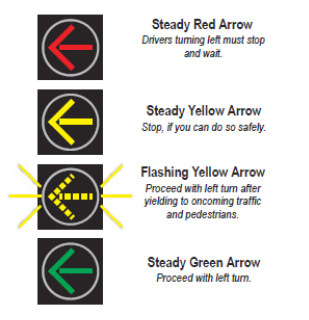
The picture at right is basically all the government really tells you about flashing
yellow arrows.
They need to tell you more.
- Left turning drivers seeing this signal face must look at it to know the right thing to do.
- The other signal faces can give you the WRONG information on what to do.
- Left-turning drivers must NEVER look at them or use them as their signals.
- WHENEVER THE FLASHING YELLOW ARROW IS FLASHING, ONCOMING TRAFFIC HAS GREEN.
- This is always true no matter what the other signals you can see are displaying.
- The only exception is if there is no oncoming road. Then the flashing arrow
is protecting pedestrians.
HIDE THE OTHER SIGNALS
This is the same trick they used with Dallas Phasing. Circular greens are hidden from other traffic:
- Long visors on the left.
- Louvers
- Optically programmed signal sections (expensive)
- A sign blank mounted on the left side of the signal face
- Some kind of view blocker
ONCOMING TRAFFIC HAS GREEN
IF
IS FLASHING
SIGNS
This is education at the signal.
- ONCOMING TRAFFIC HAS EXTENDED GREEN
- LEFT TURNS MUST USE THIS SIGNAL
- LEFT TURN ON GREEN ARROW OR FLASHING YELLOW ARROW ONLY
- LEFT TURN ON ARROWS ONLY
- ONCOMING TRAFFIC HAS GREEN IF YELLOW ARROW IS FLASHING
This is in addition to the
LEFT TURN YIELD ON FLASHING YELLOW ARROW
sign.

LEAD-LAG SIGNAL OPERATION
HOW THE LEAD-LAG SIGNAL WORKS:
- Start will all signals red.
- The leading side gets thru green and a green turn arrow.
The lagging side gets flashing yellow arrow to turn through gaps.
- The green arrow turns yellow, and then to flashing yellow arrow.
The lagging side turns green when the green arrow traffic has cleared.
- The leading side thru greens turn yellow and red.
The flashing yellow arrow continues letting cars turn through gaps.
The lagging side gets its green turn arrow once the leading thru traffic clears.
- Signals on both sides turn yellow and red, and the cross street gets its greens.
As you can see, the flashing yellow arrow on either side does not begin or end at the
same time the thru (circular) green on that side begins or ends.
So you can NOT look at the circular green to find out if the turn is allowed or not.
The flashing yellow arrow is flashing at any time the oncoming thru green is on.
WE MUST RECOVER THE USE OF FLASHING YELLOW ARROWS FROM THE WHIMS OF DRIVERS.
THE LOSS OF INTERSECTION EFFICIENCY IS TOO GREAT TO NOT USE THEM.