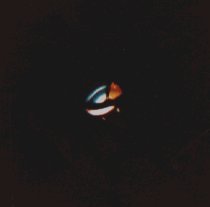
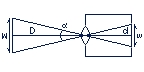
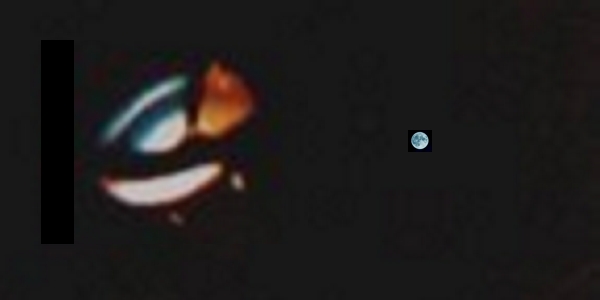
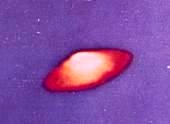
The angular size of the object on the film is quite large - so large that, if the object had
been "high", it would have been extremely large. But it is not so well known that the
unaided human eye cannot determine the speed, altitude, distance, or size of any unknown object
more than 30 feet away which is seen against the sky. So we do not really know the true size of
the object. But at least one of the following must be true for the image on the film to
exist:
- The object was a lot smaller and a lot closer to the camera.
- The object was huge.
- The photo was not taken as claimed.
- The photo was faked.
- The wrong negative was printed.
Alan Smith's description of the angular size of the visual object is such that the object
would not produce an image of the size obtained without a telephoto lens. Alan had a simple
Boy Scout camera. An object the angular size that Alan reported to have seen visually would have
left an image on the negative that was too small to be seen without magnification. The image
should also have been in the center of the frame. Thus, the negative that was printed was not
a negative of one of the shots attempted at the time of the sighting.
Note: the page author once shot photos of airplane lights at night, to use as a reference
shot for angular size in a photo. A simple camera was used. Magnification was necessary to find
the plane lights in the otherwise dark frame.
One other thing doesn't make sense. Most people bought black and white film for most
photography in 1965, because color film cost about three times the price of black and white.
They usually bought one roll of color film for Christmastime photos. It makes sense that a roll
might still be in a camera from Christmas, but not a fresh roll of color film in August, unless
the family had a lot of money. A lower item suggests that they did not have this money.
There are no stars visible in the photo. This may be due to the shortness of the exposure, or
because no stars were there. According to other witnesses in Oklahoma that night, there were
stars visible in the sky.
Note that most of the photos taken by others were of scintillating stars. Scintillation is
the breaking up of starlight by the uneven refraction in the earth's atmosphere. It makes stars
and planets flash with different colors.
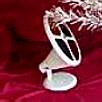
The shape of the object suggests a circular or elliptical light source with some kind of
coloring media in front of it. Here are photos of the most likely object that was in the
photograph:
A contact print of a negative strip was printed in a UFO book, purporting to show that the
UFO photo was between Christmas photos. But Alan says that the roll of film was new, and that
the strip containing the photo was cut apart when he had it printed again, so he wouldn't be
charged for all 4 pictures (indicating not a lot of money available). If it was cut apart,
where did the book author get the strip? (I am trying to track down this book again.)
Flashbulbs were quite unreliable in the 1960s. My main theory is that this photo was the
result of a flashbulb failing to go off. Thus, the film recorded only the one direct light
source in the field of view.